When we design materials, we don’t start with content—we start with the realities of the modern classroom.
Classrooms today are complex, dynamic spaces. Students bring different linguistic backgrounds, learning preferences, levels of confidence, and lived experiences into the room. Some are highly verbal, others process visually. Some thrive in structured environments, while others need flexibility and creative freedom. Increasingly, teachers are also navigating neurodiversity, multilingualism, and wide gaps in prior knowledge—all within the same class period, and oftentimes, without a great support system.
So instead of asking, “What should this lesson include?” we ask a different question:
“How can this material adapt to the learners in front of it?”
Adaptability as a Design Principle—not an Afterthought
From the earliest stages of development, adaptability has been central to our materials—not something added on later, but something built into their core.
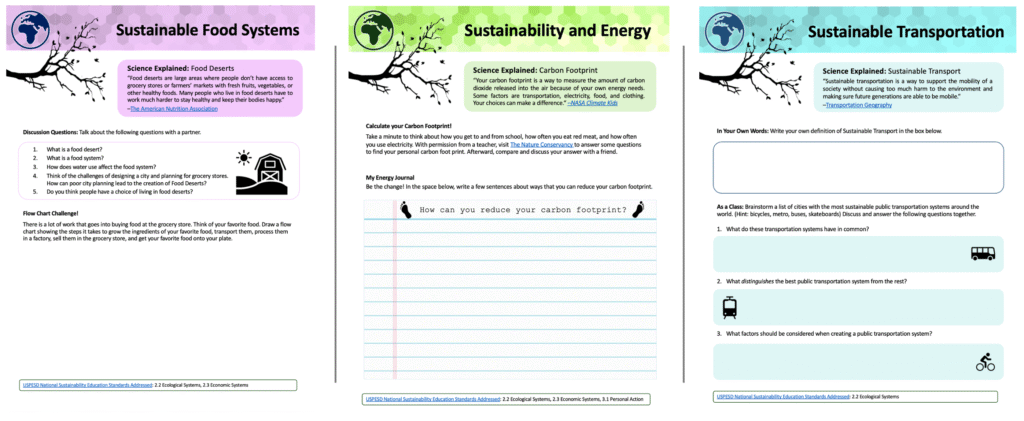
In the initial phase of her doctoral research (2020), Haley designed materials that were intentionally simple: stand-alone CLIL sustainability worksheets designed to explore feasibility and gather baseline student responses. These early resources were not supported by teacher guides or formal assessments, but they were still grounded in strong design principles.
Following Tomlinson (2011), they aimed to:
- meet learner needs
- create positive feelings
- promote meaningful, relevant learning
Even at this stage, adaptability showed up in subtle ways—through open-ended questions, accessible topics like energy, food, and transportation, and opportunities for students to connect global sustainability issues to their own communities.
But as the project evolved, so did the depth—and the intentionality—of adaptability.
Designing for Real Classrooms: The Shift to Structured Flexibility
By 2023, the materials had grown into a full 10-unit CLIL sustainability curriculum. With that expansion came a deeper commitment to designing for diverse, real-world learning environments.
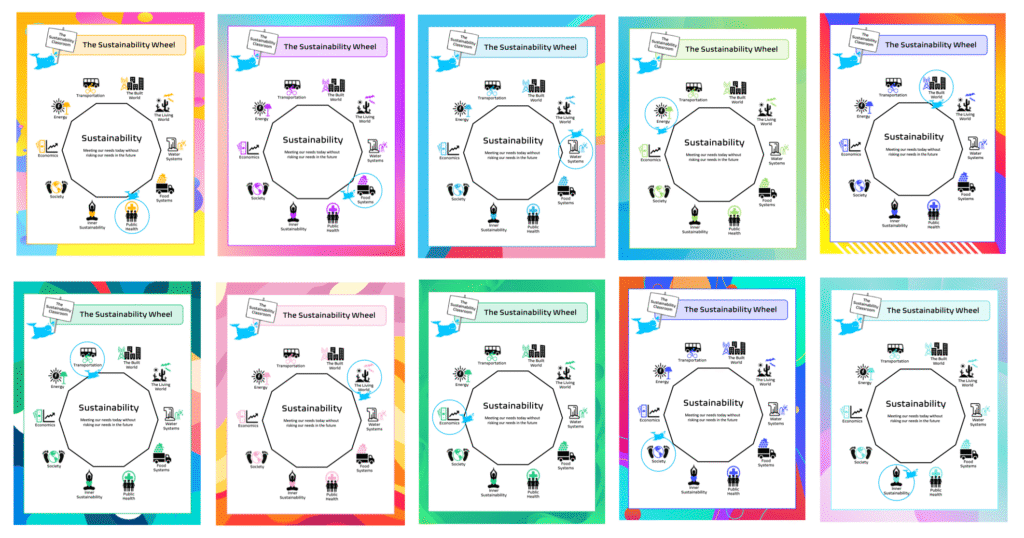
These units were built for students aged 11–16 across contexts like the Basque Country and the United States—two settings with very different relationships to language, curriculum, and sustainability education.
That meant one thing: The materials couldn’t be rigid. They had to flex.
So adaptability was addressed at multiple levels:
1. Linguistic Flexibility
Students engage with all four language skills—reading, listening, speaking, and writing—but with particular support for production, especially speaking.
- Scaffolded tasks guide learners from supported interaction to independent expression
- Activities can be simplified or extended depending on proficiency
- Teachers can choose whether to incorporate translanguaging, depending on their classroom policy
This ensures that both emerging and confident language users can participate meaningfully.
Because students’ linguistic abilities can vary widely, the materials are intentionally designed to be open-ended. This flexibility allows them to integrate naturally with the English content students are already developing in the classroom, supporting both continuity and differentiated language growth.
For example, students might practice conditional structures through sustainability topics—“If people used more public transportation, pollution would decrease”—adapting both the language and the complexity of their ideas to their level.
2. Cognitive and Neurodiverse Accessibility
No two learners process information in the same way. That’s why the materials incorporate:
- Multimodal input (visuals, text, video, discussion)
- Creative and analytical tasks (e.g., flowcharts, debates, research projects)
- Structured + open-ended activities to support both guided and independent thinking
Inspired by theories like multiple intelligences (Gardner, 1993), the Zone of Proximal Development (Vygotsky, 1978), the four-dimensional student engagement framework (Reeve, 2012), and cognitive load management strategies (Kapoor, 2024), each unit creates multiple entry points into learning.
For neurodivergent learners, this means:
- reduced reliance on a single mode of expression
- opportunities to demonstrate understanding in different ways
- a balance between predictability and flexibility
- establishing routines and positive associations with the material
- contributing to the development of learning opportunities
3. Social and Emotional Adaptability (SEL Integration)
Forward-thinking education recognizes that students are more than academic performers—it addresses the whole learner, including their emotional and social development. This approach challenges educators to move beyond content delivery and become leaders in social-emotional learning, creating environments where students feel supported and capable.
The materials embed Social and Emotional Learning (SEL) by:
- encouraging collaboration and peer interaction
- promoting self-reflection and student voice
- connecting content to real-life decision-making
For example, in the Sustainability and Food Systems unit, students don’t just learn vocabulary—they reflect on their own food choices, community access, and environmental impact. This encourages agency and investment in their own learning, as well as in their interactions with the world around them.
We can create space for students with different backgrounds and experiences to engage in ways that feel relevant and personal.
4. Teacher Adaptability (Because Teachers Need It Too)
One of the most important facets of materials design is this:
If materials aren’t adaptable for teachers, they won’t be used effectively.
Teachers today face time constraints, curriculum pressures, and varying levels of familiarity with CLIL and sustainability education. So the materials are designed to reduce—not increase—teacher workload:
- Clear, concise instructor guides
- Estimated timings for each activity
- Optional extensions and modifications
- Flexible use of technology and new pedagogies
Teachers can follow the lesson as written, adapt it, shorten it, or expand it—depending on their context.
Built-In Adaptability Through Structure: The 3 C’s
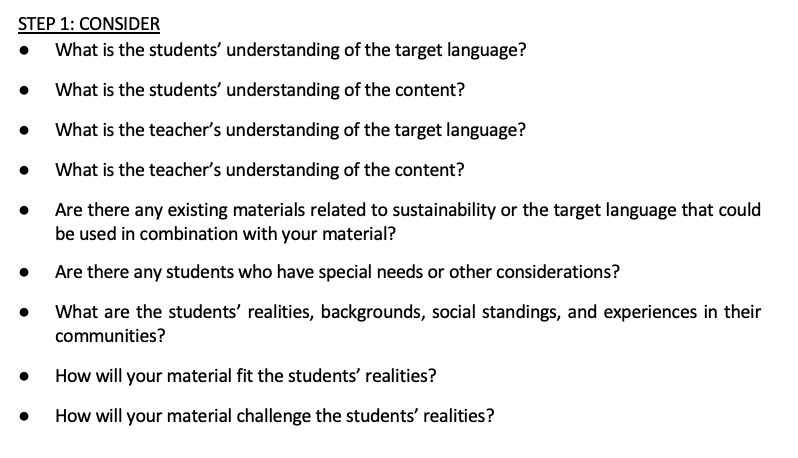
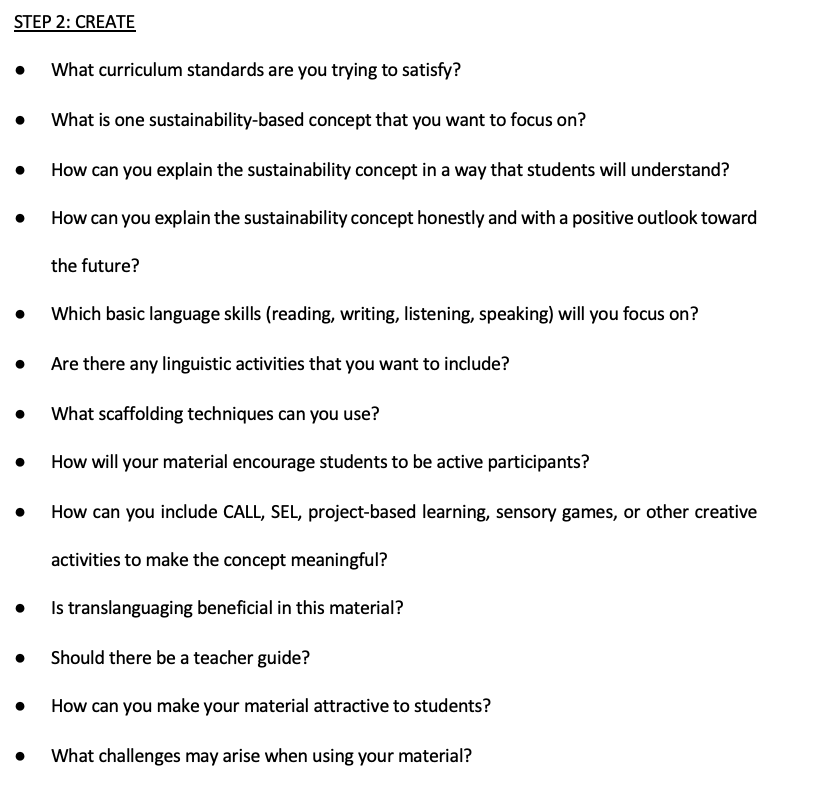
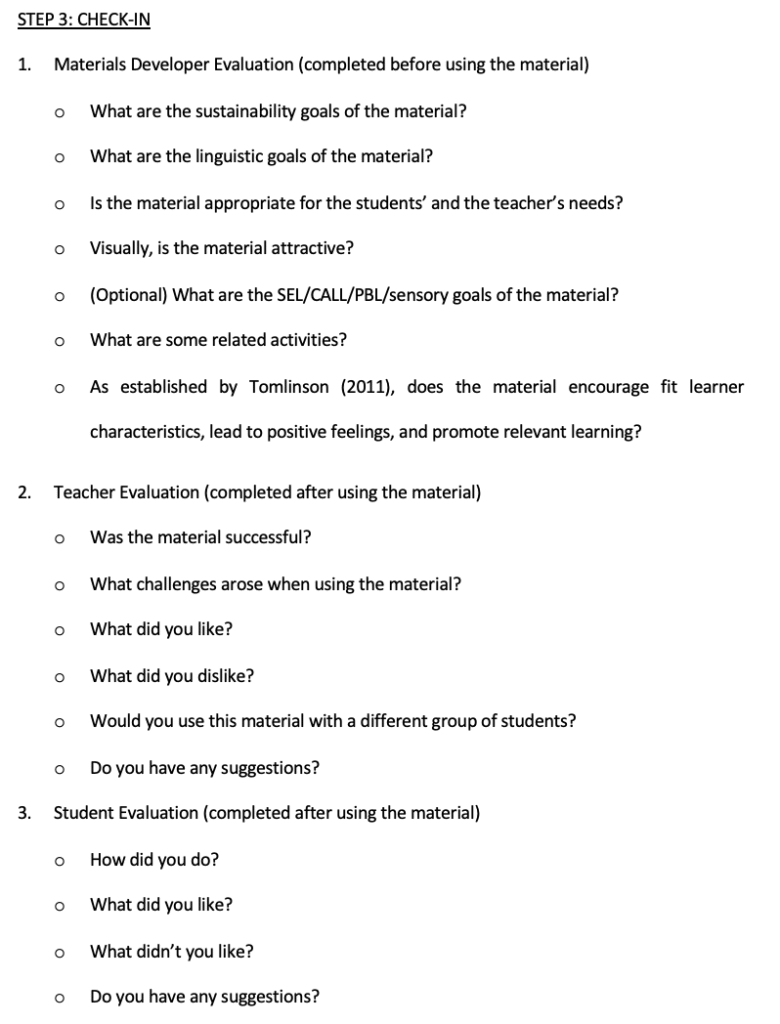
To ensure adaptability isn’t left to chance, the materials follow a structured design process based on Penny & Ruiz de Zarobe (2024, pp. 339-340)’s 3 C’s Framework:
Adaptability in Action: A Classroom Example
In each unit, adaptability is visible in the progression of tasks:
- Individual engagement with content
- One-on-one interaction
- Vocabulary development
- Listening comprehension
- Guided group discussion
- Collaborative presentation
Each stage builds on the previous one—but teachers can pause, extend, or modify at any point.
Even assessment is adaptable:
- Pre-tests allow students to respond through writing, drawing, or conversation
- Post-tests include self-reflection and feedback
- Evaluation becomes part of learning, not just measurement
Designing for the Modern Learner
At its core, adaptability is about respect.
It’s about recognizing that:
- learners are not uniform
- classrooms are not static
- and education cannot be one-size-fits-all
Research in materials development consistently points in this direction.
Effective materials:
- center the learner (Mehisto, 2012)
- foster motivation and engagement (Dörnyei & Ushioda, 2009)
- integrate critical thinking and real-world relevance
- and remain flexible enough to function across contexts
But there’s also a practical reality:
Teachers often don’t have the time or resources to constantly create or adapt materials themselves.
That’s why adaptability must be embedded into the design from the beginning.
Final Thoughts
Adaptability doesn’t mean lowering standards or making things easier. It means making learning possible, meaningful, and engaging for more students.
When materials are designed with adaptability at the center, they do more than deliver content—they create space:
- for different voices
- for different ways of thinking
- for real connection to the world beyond the classroom
And in a field like sustainability education—where the goal is to prepare students for complex, evolving global challenges—that kind of flexibility isn’t optional.
It’s essential.
Bibliography
Dörnyei, Z., & Ushioda, E. (Eds.). (2009). Motivation, language identity and the L2 self. Multilingual Matters.
Gardner, H. (1993). Multiple intelligences: The theory in practice. Basic Books.
Kapoor, B. (2024). The influence of universal design for learning on primary school students’ social and emotional competence. In S. Gorard & N. Siddigui (Eds.) An international approach to developing early career researchers (pp. 62-75). Routledge.
Mehisto, P. (2012). Criteria for producing CLIL learning material. Encuentro, 21(2), 16–17. https://files.eric.ed.gov/fulltext/ED539729.pdf
Penny, H. & Ruiz de Zarobe, Y. (2024). Effective CLIL materials design: A focus on sustainability education and the holistic learner in Spain. In Cirocki, A., Farrelly, R., Sapp, T. (Eds.) Developing materials for innovative teaching and sustainable learning. Springer texts in education. Springer, Cham. https://doi.org/10.1007/978-3-031-69206-2_13
Reeve, J. (2012). A self-determination theory perspective on student engagement. In S. L. Christenson, A. L. Reschly, & C. Wylie (Eds.), Handbook of research on student engagement (pp. 149–172). Springer. https://doi.org/10.1007/978-1-4614-2018-7_7
Tomlinson, B. (2011). Materials development in language teaching (2nd ed.). Cambridge University Press. https://doi.org/10.1017/9781139042789
Vygotsky, L. S. (1978). Mind in society: Development of higher psychological processes. Harvard University Press.